Lifeline Requirements: Documents and Apply
If you’re looking up Lifeline requirements, you probably want a clear checklist you can trust.
You also want to know what counts as real eligibility, what documents matter, and how to avoid wasting time on confusing “free phone” hype.
The good news is that Lifeline is a real federal benefit, and the rules are actually pretty straightforward once you see them laid out.
The key is understanding that Lifeline is primarily a monthly discount for eligible households, and providers may add device offers on top of that.
Important notice: This content is independent and informational.
We are not affiliated with, sponsored by, or in control of the FCC, USAC, Lifeline, the National Verifier, or any provider mentioned, including Assurance Wireless.
Providers control their own plans and device inventory, and program rules and eligibility details can change.
Lifeline requirements: the real eligibility basics
Lifeline requirements are mainly about proving that your household meets eligibility rules.
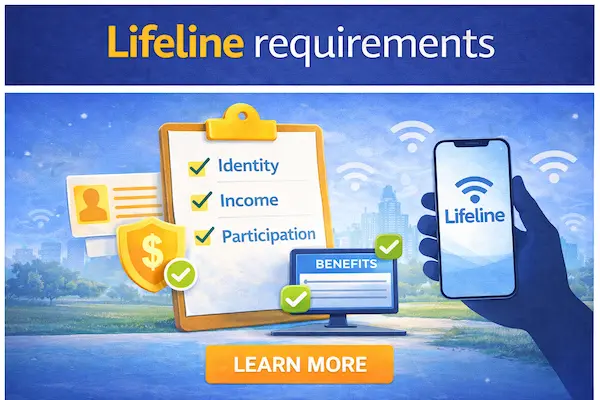
You typically qualify in one of two ways: by Lifeline income eligibility or by participation in a qualifying assistance program.
The FCC explains that you may qualify if your household income is at or below 135% of the Federal Poverty Guidelines, or if you participate in certain qualifying programs.
USAC, which administers Lifeline, also lists the same two main pathways: income-based or program-based eligibility.
So when you see searches like Lifeline eligibility requirements and Lifeline qualifications, they’re usually pointing to these same two options.
If you only remember one thing, remember this: eligibility is about your household, and Lifeline is limited to one benefit per household.
That “one-per-household” rule is why it’s important to use consistent address information in every step of your application.
It’s also why some applications get delayed, even when a person truly qualifies.
What counts as “household” in Lifeline
A household generally means people who share income and expenses at the same address.
If multiple families live at one address but do not share income and expenses, you may need to complete an additional worksheet to explain that.
This is a common point of confusion when people search qualifications for government phone and assume eligibility is only about the individual.
In Lifeline, the household definition matters a lot, because it affects how many benefits can exist at one address.
Lifeline income eligibility: what “135%” really means for you
Lifeline income eligibility means your household income must be at or below 135% of the Federal Poverty Guidelines for your household size.
Those guidelines are updated annually, and the exact numbers depend on household size and sometimes location.
That’s why it’s normal to feel unsure when you see different income tables online.
The most reliable approach is to use official Lifeline sources for the current year’s numbers.
If you qualify by income, you may need to provide proof such as pay stubs, a tax return, or other accepted documentation, depending on what the verifier requests.
Think of it like this: you are not trying to “convince” anyone, you are simply matching a requirement with acceptable proof.
When the information is consistent and clear, the process is usually smoother.
Lifeline qualifications through assistance programs
If you qualify through a program, your Lifeline qualifications may be easier to verify.
USAC lists common qualifying programs such as Medicaid, SNAP, SSI, Federal Public Housing Assistance, and Veterans Pension and Survivors Benefit, among others that can vary by state and Tribal eligibility.
In many cases, the system can automatically confirm your participation.
If it cannot, you may be asked to upload proof like a benefit award letter or a screenshot of an official benefits portal.
This is one reason people search for Lifeline application help, because document requests can feel stressful if you weren’t expecting them.
Once you know it’s normal, it gets a lot easier to handle calmly.
Lifeline application: where verification fits in
Your Lifeline application is processed through the National Verifier, which is Lifeline’s centralized eligibility system managed by USAC.
That’s why you’ll see the phrase “National Verifier” in official guidance and in many provider enrollment flows.
In practical terms, the National Verifier decides whether you meet the Lifeline requirements.
After you are approved, you enroll with a participating phone or internet company for service.
This matters because a lot of “free phone” marketing skips directly to a provider pitch without explaining that eligibility comes first.
So if you’re feeling skeptical, that skepticism is healthy.
The safest mindset is “verify first, then shop providers.”
What you should prepare before starting
Before you begin the application, gather your key information and keep it consistent.
- Full legal name that matches your documents.
- Date of birth entered exactly the same way everywhere.
- Home address including apartment or unit number.
- Eligibility pathway (income-based or program-based) chosen correctly.
- Proof documents ready in case the system requests them.
This small prep step can prevent the most common delays.
Lifeline apply: the clean step-by-step process
If your goal is to Lifeline apply without confusion, follow a simple sequence.
This is the same structure that helps you whether you want phone service, internet service, or both if available in your area.
- Confirm your eligibility path using income or qualifying program participation.
- Start your Lifeline application through the National Verifier flow.
- Submit accurate personal and household information with consistent spelling and formatting.
- Upload documents only if requested, making sure images are readable and current.
- Wait for an eligibility decision and save your confirmation details.
- Choose a participating provider that serves your zip code and enroll in a plan.
- Activate your service and follow provider instructions for SIM setup or device delivery.
USAC also explains that consumers apply for Lifeline, then sign up with a participating phone or internet company, and must keep their benefit current through annual processes.
That is the backbone of the program, even when ads make it sound like a one-click “free phone” giveaway.
Apply for Lifeline cell phone: what happens after you’re approved
When you apply for Lifeline cell phone service, the approval is not the final step.
Approval means you are eligible for the Lifeline benefit, and now you can enroll with a provider offering Lifeline-supported service in your area.
At this stage, you compare plans like data amounts, coverage, and support options.
You also check whether the provider offers a phone, a discounted device, or a bring-your-own-phone option.
This is where people often get disappointed, because they expected a specific phone model.
The more realistic expectation is that your benefit supports affordability, and device offers vary by provider and inventory.
So if you are searching “qualifications for government phone,” it helps to translate that into “qualifications for the Lifeline benefit and then provider enrollment.”
A quick plan comparison checklist
- Coverage where you actually live and work.
- Data policy, including what happens after high-speed data is used.
- Hotspot rules if you rely on tethering.
- Device terms, including replacement and warranty policies.
- Support access, including how you resolve activation issues.
These details matter more than a flashy headline.
Assurance Wireless apply: how provider applications fit Lifeline requirements
You may see searches like Assurance Wireless apply because provider applications can be a convenient route for some people.
Assurance Wireless provides Lifeline-supported service in certain areas and explains that, along with proof of eligibility, applicants may need to provide proof of identity and address.
That’s also why you’ll see keyword variations like Assurance Wireless qualifications and Assurance Wireless requirements.
In general, those provider requirements usually include the same Lifeline eligibility rules, plus provider-specific steps like identity verification and delivery or activation procedures.
If you decide to apply through a provider, you still want to make sure you are completing the legitimate eligibility process.
A provider route can be perfectly valid, but it should still align with the National Verifier and official Lifeline rules.
How to stay safe when applying through a provider
- Confirm the provider serves your zip code before you share sensitive information.
- Look for clear Lifeline disclosures about eligibility and one-per-household rules.
- Review plan terms so you know what you are enrolling in.
- Save confirmations such as reference numbers, emails, and screenshots.
This keeps you in control, even if a page is trying to rush you.
Lifeline requirements that surprise people the most
Most people assume the hardest part is “getting approved.”
In reality, the hardest part is usually consistency, follow-through, and keeping the benefit active.
USAC explains that Lifeline includes ongoing responsibilities like recertification.
USAC also states that recertification is an annual requirement to ensure active subscribers are still eligible.
And Lifeline Support materials warn that if you are asked to recertify, you must respond within the required timeframe or you can lose the benefit.
So yes, meeting the initial Lifeline requirements matters, but staying eligible over time matters too.
The “hidden” requirements that cause interruptions
- Annual recertification when you are prompted to confirm eligibility.
- Keeping your contact information current so you do not miss notices.
- Using the service as required by your provider’s rules to keep the line active.
- Updating household changes that affect eligibility or one-per-household rules.
When you expect these responsibilities, they stop feeling like surprises.
Qualifications for government phone: a quick myth check
When people say “government phone,” they usually mean Lifeline-supported phone service offered by a participating company.
That’s why you see the phrase qualifications for government phone everywhere.
The myth is that there is one universal “government phone” application that automatically ships a phone to your door.
The reality is eligibility is verified through the National Verifier, and then you enroll with a provider for service.
A phone may be included, but it is not promised by Lifeline itself, and it depends on provider terms and inventory.
Once you understand that, you can stop chasing gimmicks and focus on the steps that actually work.
Your next step if you want to meet Lifeline requirements quickly
If you want to meet Lifeline requirements and move forward fast, do two things today.
First, choose your eligibility path, either Lifeline income eligibility or program participation.
Second, prepare clear documents and enter your personal details consistently so verification does not stall.
After approval, compare providers based on coverage and plan details, not just the promise of a “free phone.”
That’s how you turn a confusing search into a clean result you can actually use.