
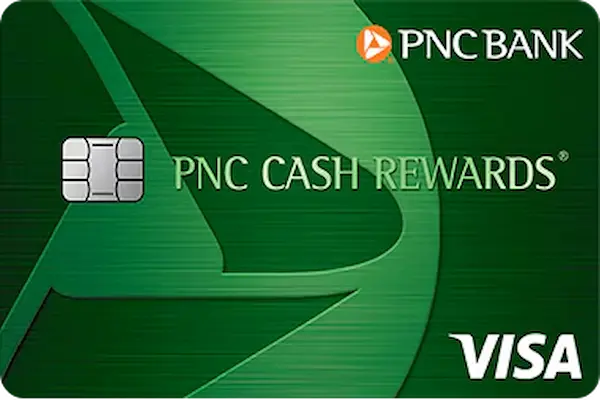
How to apply for the card PNC Cash Rewards® Visa® Credit Card
Learn how the PNC Cash Rewards® Visa® Credit Card works, including 4% cash back on gas.
3% on dining, 2% on grocery stores, the $8,000 annual cap, the $200 bonus, balance transfer intro APR details, key fees, and application checklist.
Overview of the PNC Cash Rewards® Visa® Credit Card
The PNC Cash Rewards® Visa® Credit Card is a cash back card built around three everyday categories.
It focuses on rewarding gas station purchases, dining purchases at restaurants, and grocery store purchases.
Instead of rotating categories, the bonus structure stays consistent, but the higher rates are limited by an annual spending cap.
The card is also positioned as a no-annual-fee option, which keeps the long-term cost straightforward.
If you like the idea of earning more in a few common categories while keeping everything else simple at 1%, this card is designed to feel predictable.
Who this card is designed for
This card tends to fit people who spend regularly on gas, restaurants, and groceries.
It can be especially useful for commuters, families, and anyone who does routine weekly grocery runs.
It can also work as a “category card” alongside a flat-rate cash back card, where you use PNC Cash Rewards for its best categories and another card for everything else.
If you prefer a single “catch-all” card for every purchase, the annual cap and the 1% base rate after you exceed it may feel limiting.
Credit card basics
The PNC Cash Rewards® Visa® Credit Card is a standard credit card, not a charge card.
That means you receive a credit limit and a monthly statement.
You can pay in full to avoid interest, or carry a balance and pay interest under the card’s APR terms.
The “value equation” in one paragraph
The value equation comes down to two questions.
First, do your gas, dining, and grocery spending fit inside the annual cap where the best rates apply.
Second, do you actually spend enough in those categories for the higher earnings to matter compared with a simpler flat-rate card.
If the answer to both is yes, the structure can make sense because it rewards the spending many households already have.
If your spending in those categories is very high, you may hit the cap early and see more of your year earning only 1%.
Quick facts (scannable summary)
Key fees for the PNC Cash Rewards® Visa® Credit Card
Annual fee: $0.
Foreign transaction fee: 3% of each foreign transaction amount in U.S. dollars.
Balance transfer fee: either $5 or 4% of the amount of each balance transfer, whichever is greater, for the first 90 days following account opening.
Balance transfer fee after that: either $5 or 5% of the amount of each balance transfer, whichever is greater.
Cash advance fee: either $10 or 5% of the amount of each cash advance, whichever is greater.
Late payment fee: up to $38.
Returned payment fee: up to $38.
Fees can change, so always confirm the current “Important Information About Rates and Fees” before you apply.
Reward structure for the PNC Cash Rewards® Visa® Credit Card
You earn 4% cash back on gas station purchases.
You earn 3% cash back on dining purchases at restaurants.
You earn 2% cash back on grocery store purchases.
You earn 1% cash back on all other purchases.
The 4%, 3%, and 2% rates apply to the first $8,000 in combined purchases in those categories annually.
After the first $8,000 in combined purchases that earn 4%, 3%, or 2%, you generally earn 1% on purchases until your next anniversary date.
Rewards are based on merchant category codes, which means the merchant’s classification can affect whether a purchase qualifies.
Rewards never expire as long as your account is open.
Core benefits (top 5)
- $0 annual fee.
- High cash back on gas, dining, and grocery store purchases, subject to the annual cap.
- A $200 account opening bonus after meeting the purchase requirement in the first 3 months.
- A 0% intro APR offer on qualifying balance transfers for 15 months, subject to timing rules.
- Flexible redemption options such as statement credit or direct deposit into an eligible PNC account, with a $25 minimum redemption threshold.
Eligibility and approval: what typically matters
Credit profile expectations (general, no promises)
Approval decisions usually look at your full credit profile, not just one number.
Issuers generally consider your payment history and whether you pay on time.
They look at utilization, which is how much of your available credit you are currently using.
They consider the length of your credit history and your mix of accounts.
They also look at recent inquiries and how many new accounts you have opened lately.
Income and existing obligations matter because lenders want to see that a new credit line fits your budget.
Nothing here guarantees approval, because underwriting is based on the issuer’s internal criteria at the time you apply.
Income and spending patterns that may help (general guidance)
Applications usually ask for income and housing costs.
Providing accurate information matters because it supports affordability review.
If you plan to use a balance transfer offer, it is smart to map out how you would pay the debt down before the intro period ends.
If your goal is rewards, paying in full tends to keep the rewards valuable because interest charges can outweigh cash back quickly.
Application flow
This card is not positioned as invite-only.
Most people apply through a normal consumer credit card application process.
Some applicants receive a quick decision, while others may be asked for verification.
Fees and costs you must understand first
Annual fee breakdown and what’s included
The annual fee is $0.
That lowers the pressure to “justify” the card with credits or premium perks.
Your value mainly comes from how well the gas, dining, and grocery categories fit your real spending.
APR ranges and why they matter even for rewards cards
The card has a variable APR range that depends on creditworthiness.
If you carry balances, interest can easily outpace the value of 2% to 4% cash back.
If your plan is to pay in full, APR matters less for daily use, but it still matters as a safety factor for unexpected months.
Balance transfers and the timing rules
The card offers a 0% intro APR on qualifying balance transfers for the first 15 months following account opening.
To qualify for that intro rate, the balance transfer typically needs to be made within the first 90 days following account opening.
After the intro period ends, the balance transfer APR becomes a variable rate based on creditworthiness.
The most important detail is that 0% intro APR is a time window.
If you still have a balance after the window ends, the remaining amount can begin accruing interest at the standard rate.
The balance transfer fee “real math”
The balance transfer fee is a real cost that hits immediately.
If you transfer $5,000 within the first 90 days, a 4% fee would be $200, assuming $5 is not the greater amount.
If you transfer after the first 90 days, a 5% fee would be $250 on that same $5,000 transfer, again assuming $5 is not the greater amount.
A balance transfer can still be useful if it replaces higher interest elsewhere, but you should calculate the fee and compare it to the interest you would otherwise pay.
Foreign transaction fees and travel reality
A 3% foreign transaction fee can make international travel and foreign online shopping more expensive.
If you travel often, you may prefer a separate card with no foreign transaction fee for overseas purchases.
You can still keep this card for domestic gas, dining, and grocery spending where it is designed to earn more.
Rewards: earning and redemption (the real math)
How the PNC Cash Rewards® Visa® Credit Card earns cash back
The earning structure is simple on the surface and detailed underneath.
You earn 4% at gas stations, 3% at restaurants, and 2% at grocery stores.
Everything else earns 1%.
The main constraint is the annual cap that applies to the combined spending in the 4%, 3%, and 2% categories.
Once your combined spending in those categories reaches $8,000 in a program year, additional purchases in those categories typically earn 1% until your next anniversary date.
What the $8,000 annual cap means in practice
The cap is not per category.
The cap is combined across gas station purchases, dining purchases at restaurants, and grocery store purchases.
That means one category can “use up” the cap and reduce the bonus earning you get from the others later in the year.
If you want to optimize, it helps to estimate your annual spending across all three categories, not just one.
Quick cap math you can do in your head
If you spend $8,000 total across gas, dining, and groceries in a program year, then all $8,000 can earn at the bonus rates.
If you spend $10,000 total across those categories, then about $2,000 of that spend will likely earn 1% instead of the higher rate, depending on timing.
If you spend far more than $8,000 in those categories, you may want a second card for “overflow” once you hit the cap.
Merchant category codes can change the result
The card’s rewards are determined by the merchant category code used to classify the transaction.
That classification is controlled by the payment network and the merchant’s processor, not by you.
A purchase you think of as “groceries” may not code as groceries if it is made at a superstore, warehouse club, drugstore, or convenience store.
A purchase you think of as “gas” may not code as gas if it is purchased at a superstore or a merchant that does not code as a gas station.
A purchase you think of as “dining” may not code as dining if it is processed under a different category.
The practical best practice is to review your first month of transactions to confirm how your most-used merchants are coding.
Redemption basics
PNC allows you to redeem cash back in the PNC Mobile app or in Online Banking once you have at least $25 in your cash rewards account.
Redemption options include statement credit and direct deposit into eligible PNC accounts.
A statement credit reduces your balance, but it is not the same as making a payment, so you still need to make at least your minimum payment due.
Rewards never expire as long as your account is open, which reduces pressure to redeem immediately.
Example scenarios with simple numbers
Scenario A: You spend $3,000 on gas, $3,000 on dining, and $2,000 on groceries in one year.
That total is $8,000 across the bonus categories, which fits inside the cap.
In a simplified view, that could produce about $120 from gas at 4%, about $90 from dining at 3%, and about $40 from groceries at 2%, for about $250 in cash back from those categories.
Your additional spending outside those categories would earn 1%.
Scenario B: You spend $4,000 on gas, $4,000 on dining, and $4,000 on groceries in one year.
That is $12,000 across the bonus categories, which exceeds the $8,000 cap.
In that simplified view, the first $8,000 earns at the higher rates, and the remaining $4,000 in those categories generally earns 1% until the next anniversary date.
The key lesson is that the cap affects heavy category spenders much more than moderate category spenders.
These examples are illustrative and assume purchases qualify and code as expected.
Benefits deep dive
The welcome bonus and what to watch
The card advertises a $200 bonus when you make $1,000 or more in purchases during the first 3 months following account opening.
There is also a bonus eligibility restriction that limits how often a customer can receive a new account opening bonus for the same product.
The safest way to think about a welcome bonus is as a one-time perk that should come from normal spending.
If you have to force spending to reach a bonus, the value can disappear quickly.
A note on “purchases” and exclusions
Rewards programs commonly exclude certain transactions from earning rewards.
Typical exclusions can include interest, fees, balance transfers, cash advances, and some financial transactions.
Returns and credits can reduce rewards because many programs calculate rewards based on net purchases.
To avoid surprises, treat rewards as something you confirm in your account activity rather than something you assume for every transaction type.
Balance transfer intro APR as a planning tool
The balance transfer offer can be useful if your goal is to reorganize debt.
The key is to plan the monthly payment that will fully pay off the transferred balance before the intro window ends.
A balance transfer offer works best when it supports a payoff plan you would follow anyway.
Day-to-day usability
This card is designed to be easy to remember.
Use it at the pump.
Use it at restaurants.
Use it at grocery stores that code as grocery stores.
Use another card for everything else if you want a higher base rate than 1%.
That simple pattern is often how people get the best practical value from category cards with caps.
Pros and cons
Pros of the PNC Cash Rewards® Visa® Credit Card
- $0 annual fee keeps the ongoing cost low.
- Strong category earning for gas stations, restaurants, and grocery stores, subject to the annual cap.
- Straightforward redemption options with a clear $25 minimum threshold.
- Rewards do not expire as long as the account remains open.
- A welcome bonus can add early value if you can meet the spending requirement with normal purchases.
- A balance transfer intro APR offer can be useful for debt organization if you understand the fee and the timing rules.
Cons of the PNC Cash Rewards® Visa® Credit Card
- The $8,000 annual cap applies across all three bonus categories combined.
- After the cap is reached, purchases in those categories generally earn 1% until the next anniversary date.
- A 3% foreign transaction fee makes it less attractive for international travel and foreign online merchants.
- Merchant category coding can cause purchases to earn less than expected.
- The 1% base rate can be weak compared with flat-rate 2% cards for non-category spending.
Who this card is best for (and who should skip)
Best-fit profiles (3 profiles)
Profile 1: The commuter who spends steadily at gas stations and wants a higher return on that predictable expense.
Profile 2: The household that eats out regularly and also has meaningful grocery spend that fits inside the annual cap.
Profile 3: The two-card strategist who will pair this card with a flat-rate card for everything outside gas, dining, and groceries.
Not a fit if… (3 profiles)
Not a fit 1: You want one card that earns a strong flat rate everywhere without managing caps.
Not a fit 2: You travel internationally often and want no foreign transaction fee.
Not a fit 3: Most of your “grocery” spending happens at superstores or warehouse clubs that may not code as grocery stores.
Head-to-head comparisons (SEO powerhouse)
PNC Cash Rewards® Visa® Credit Card vs a flat-rate 2% cash back card
A flat-rate 2% card is simple because almost everything earns the same strong rate.
PNC Cash Rewards can beat a flat-rate card in its best categories before the cap is reached.
After you hit the cap, the advantage shrinks because those category purchases generally earn 1%.
In real life, many people use PNC Cash Rewards for gas and restaurants and use a flat-rate card for everything else, especially once they approach the annual cap.
PNC Cash Rewards® Visa® Credit Card vs a rotating 5% category card
Rotating 5% cards can offer higher upside in certain quarters, but they require quarterly activation and category tracking.
PNC Cash Rewards is easier to remember because the categories are consistent.
Rotating 5% cards usually have quarterly caps, while PNC uses an annual cap across three categories.
If you dislike activations and calendars, PNC’s consistency can be more comfortable.
If you enjoy optimization and your spending aligns with rotating categories, a 5% calendar card can outperform in specific periods.
What you give up or gain at each price tier
At the $0 annual fee tier, the biggest decision is usually simplicity versus category power.
PNC Cash Rewards offers category power in three everyday areas with an annual cap.
Premium annual-fee cards often add travel perks and credits, but they require you to use those perks consistently to justify the fee.
If your goal is cash back and predictability, a no-annual-fee approach is often easier to maintain long term.
How to apply for the PNC Cash Rewards® Visa® Credit Card step by step
Application steps
Step 1: Review the current offer details, including the welcome bonus terms and the balance transfer intro APR terms.
Step 2: Confirm you understand the rewards structure and the $8,000 annual cap across the 4%, 3%, and 2% categories.
Step 3: Gather your basic information, including address history, income, and housing costs.
Step 4: Submit the application with accurate information.
Step 5: If requested, complete identity verification or provide additional documentation.
Step 6: After approval, set up online access and alerts for payment due dates.
Step 7: If you plan to do a balance transfer, initiate it within the timing window for the intro offer and account for the transfer fee.
Step 8: Set up autopay or reminders so you do not miss payments, because late payments can trigger fees and may affect promotional rates.
What to prepare before you apply
Know your annual income and your monthly housing payment.
Have your identifying information ready for the application.
If you want the welcome bonus, plan how your normal spending will reach $1,000 in purchases in 3 months.
If you want a balance transfer, gather the other creditor’s account details and estimate the fee impact before initiating the transfer.
If you want to maximize rewards, identify your most common gas stations, restaurants, and grocery stores and confirm how they typically code on credit cards once you begin using the card.
What happens after approval
You receive the card, activate it, and set up your account tools.
You decide whether to redeem via statement credit or deposit, and you keep in mind the $25 minimum redemption threshold.
You build a simple usage routine for gas, dining, and grocery purchases.
You track your annual progress toward the $8,000 cap if you want to avoid accidentally shifting into the 1% zone earlier than expected.
Alternatives if you want similar value with a different approach
Best alternative if you want simplicity everywhere
If you do not want to track caps at all, a flat-rate cash back card can be easier.
This is especially true if you spend a lot outside gas, restaurants, and grocery stores.
A flat-rate card can also reduce the need to think about merchant category coding.
Best alternative if you want higher category upside
If you want higher upside than 4% and are comfortable with quarterly activations, a rotating-category 5% card can be an option.
This approach can outperform when the calendar matches your spending, but it requires more attention.
FAQs
Is the PNC Cash Rewards® Visa® Credit Card worth it?
It can be worth considering if you spend regularly at gas stations, restaurants, and grocery stores and you can use those categories before hitting the annual cap.
It can also be a good fit if you plan to pair it with a flat-rate card for non-category purchases.
What is the annual cap and how does it work?
The 4%, 3%, and 2% cash back rates apply to the first $8,000 in combined purchases across those categories annually.
After you reach that combined cap, purchases in those categories generally earn 1% until your next anniversary date.
Does the card have an annual fee?
No, the annual fee is disclosed as none.
Does the card charge foreign transaction fees?
Yes, a foreign transaction fee is disclosed as 3% of each foreign transaction amount in U.S. dollars.
How do I redeem cash back?
You can typically redeem in the mobile app or online banking once you have at least $25 in your rewards balance.
Common redemption options include statement credit or direct deposit into eligible PNC accounts.
Do rewards expire?
Rewards are described as not expiring as long as the account is open.
Is there a balance transfer offer?
Yes, the card advertises a 0% intro APR for 15 months on qualifying balance transfers when the transfer is made within the first 90 days following account opening.
Balance transfer fees apply, so it is important to calculate the fee before transferring.
Can grocery purchases at superstores earn 2%?
Rewards depend on merchant category codes.
Purchases that you think of as groceries may not qualify if the merchant does not code as a grocery store.
Disclosures
Rates and fees disclaimer
Rates, fees, rewards terms, and promotional offers can change at any time.
Your APR, credit limit, and approval outcome depend on creditworthiness and the issuer’s underwriting.
Always review the current pricing, terms, and program rules for the specific offer you are applying under.
Editorial and affiliation disclosure
This article is for informational purposes only.
We are not PNC Bank.
We do not represent PNC Bank or Visa.
We are not affiliated with any institution mentioned.
All trademarks belong to their respective owners.


