
How to apply for the card TD Cash Credit Card
Learn how the TD Cash Credit Card works, including quarterly 3% and 2% Spend Category choices!
Enjoy $200 welcome bonus, 0% intro APR details, key fees like the foreign transaction fee, and a step-by-step guide to applying.
Overview of the TD Cash Credit Card
The TD Cash Credit Card is a cash back credit card that lets you steer higher rewards toward the categories you actually use.
Instead of locking you into one permanent bonus category, it lets you choose a 3% category and a 2% category each quarter.
You still earn 1% cash back on everything else, so the card remains usable even when life gets busy.
This is the kind of card that can feel simple on the surface, but surprisingly strategic once you understand how quarterly category choices work.
It is also positioned as a no-annual-fee card, which matters if you want rewards without paying to keep the account open.
Who this card is designed for
This card tends to fit people whose spending shifts across the year.
It also fits anyone who likes the idea of customization but does not want rotating categories assigned by the issuer.
It can be a strong option for households that routinely spend in common categories like dining, grocery stores, gas, travel, or entertainment.
It can also work well as the “category card” in a two-card setup, where another card covers non-category spending at a higher flat rate.
Charge card vs credit card
The TD Cash Credit Card is a credit card, not a charge card.
That means you have a credit limit, you receive a monthly statement, and you choose how much you pay each month.
If you pay in full by the due date, you can typically avoid interest on purchases under standard credit card rules.
If you carry a balance, interest can apply according to the APR disclosed for your offer and your creditworthiness.
The “value equation” in one paragraph
The value equation is about matching your real spending to your quarterly category picks.
If you regularly spend in the available categories and you remember to update your choices each quarter, the card can feel like it was built around your habits.
If you never change categories, you can still use the card, but you might miss out on the main reason it exists, which is customization.
And if most of your “grocery” spending happens at superstores or warehouse clubs, you will want to understand the card’s rules for those merchants before you rely on it as a grocery rewards card.
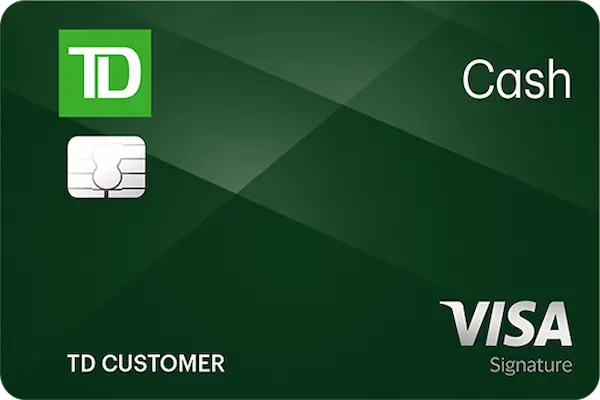
Quick facts (scannable summary)
Key fees for the TD Cash Credit Card
Annual fee: $0.
Foreign transaction fee: 3% of each transaction in U.S. dollars.
Intro APR on purchases: 0% for the first 15 billing cycles after account opening, then a variable APR range based on creditworthiness.
Intro APR on balance transfers: 0% for the first 15 billing cycles after account opening, then a variable APR range based on creditworthiness.
Balance transfer fee: an intro fee of either $5 or 3% of the amount of each transfer, whichever is greater, on transfers made within the introductory offer period.
Balance transfer fee after that: either $5 or 5% of the amount of each transfer, whichever is greater.
Cash advance APR is typically higher than the purchase APR, and cash advances usually begin accruing interest immediately.
Late payment fees and returned payment fees may apply, and the maximums depend on your account terms.
Reward structure for the TD Cash Credit Card
You choose a 3% Spend Category each quarter.
You choose a 2% Spend Category each quarter.
You earn 1% cash back on all other purchases.
At account opening, the default categories are commonly 3% on Dining and 2% at Grocery Stores.
The category choices you can pick from include Dining, Entertainment, Gas, Grocery Stores, and Travel.
Superstores and warehouse clubs generally only earn the base rate, even if their coding might otherwise look like a bonus category.
Rewards are typically described as points that can be redeemed for cash back, including a welcome bonus framed as points equal to a cash back amount.
Core benefits (top 5)
- No annual fee.
- Customizable 3% and 2% categories that you can switch quarterly.
- A welcome bonus that is commonly marketed as $200 cash back after you meet the spending requirement.
- A 0% intro APR period on purchases and balance transfers for the first 15 billing cycles under the offer terms.
- Visa benefits that can include cell phone protection when you pay your monthly mobile bill with the card, subject to terms and limits.
Eligibility and approval: what typically matters
Credit profile expectations
Approval depends on the issuer’s underwriting and your overall credit profile at the time you apply.
Issuers usually look at your payment history and whether you pay on time.
They often review your credit utilization, which is how much of your available credit you are using.
They consider the age of your accounts and the mix of credit you manage.
They also consider recent credit inquiries and newly opened accounts.
Income and existing monthly obligations matter because lenders evaluate whether repayment fits your budget.
None of these factors guarantees approval, and outcomes can differ even among applicants with similar scores.
Income and spending patterns that may help
Credit card applications typically ask for income and housing costs.
Providing accurate information matters because it supports affordability review.
If your plan is to use the card for rewards, paying in full tends to keep rewards meaningful because interest can outweigh cash back.
If your plan is to use the intro APR for financing, it helps to map out a payoff plan that fits inside the intro period.
Application flow
This is not positioned as an invite-only product.
Most people apply through a standard application process and may receive an instant decision or a pending review.
Some applicants may be asked for identity verification or additional documentation.
Fees and costs you must understand first
Annual fee breakdown and what’s included
The annual fee is $0, which keeps long-term ownership simple.
You do not need to “justify” the card with statement credits or premium perks just to break even.
Instead, your value comes from using the category structure well and managing interest costs responsibly.
Intro APR details and what they really mean
A 0% intro APR can be useful, but it is a time window, not a permanent rate.
The TD Cash Credit Card is commonly marketed with 0% intro APR on purchases and balance transfers for the first 15 billing cycles after account opening.
After the intro period ends, a variable APR applies based on creditworthiness and the terms of your approval.
If you use the intro APR to carry a balance, your best-case outcome is paying it off before the intro window ends.
If you do not, the remaining balance can begin accruing interest at the standard rate.
Balance transfers and the “fee math”
Balance transfers usually come with a fee even when the intro APR is 0%.
The TD Cash Credit Card commonly discloses an intro balance transfer fee that is the greater of $5 or 3% for transfers made within the introductory offer period.
After that, the fee is commonly the greater of $5 or 5%.
A simple way to evaluate a balance transfer is to compare the one-time transfer fee to the interest you would otherwise pay on the old debt.
If the fee is smaller than the interest you avoid and you have a payoff plan, the transfer can make sense.
If the fee is large and your payoff plan is uncertain, the transfer may not deliver the relief you expect.
Foreign transaction fee reality check
A 3% foreign transaction fee can add up quickly when you travel or buy from international merchants.
If you travel internationally often, you may want a separate card with no foreign transaction fees for overseas purchases.
You can still keep TD Cash for domestic category spending if the categories fit your routine.
Cash advances and why most people avoid them
Cash advances typically have a higher APR than purchases.
They also usually begin accruing interest immediately, without a grace period.
They also come with a cash advance fee that adds cost on day one.
For most people, cash advances are best treated as an emergency tool rather than a normal feature.
Rewards: earning and redemption
How you earn with the TD Cash Credit Card
The engine of this card is customization.
Each quarter, you select a 3% category and a 2% category from the list of eligible Spend Categories.
You earn 1% cash back on other purchases.
At account opening, the card typically defaults to 3% on Dining and 2% at Grocery Stores.
Your best results usually come from picking categories that match what you already do, not categories that look exciting on paper.
The available Spend Categories and what they usually include
Dining generally includes merchants that are primarily restaurants, including sit-down, fast-food, and similar dining merchants.
Entertainment generally includes merchants focused on recreation and entertainment, such as movie theaters, ticket agencies, amusement parks, and tourist attractions.
Gas generally includes merchants selling automotive gasoline, typically at the pump or inside the station.
Grocery Stores generally includes merchants offering a full line of groceries, often including departments like deli, bakery, and meat.
Travel generally includes merchants like airlines, hotels, car rentals, trains, buses, travel agencies, cruise lines, and it may include items like parking and tolls depending on merchant classification.
The key detail is that eligibility can depend on how a merchant is categorized, not how you personally describe the purchase.
The superstore and warehouse club limitation
Many people assume “grocery” means any place you buy food.
In credit card rewards, grocery often means merchants classified as grocery stores, not superstores or warehouse clubs.
The TD Cash Credit Card commonly discloses that superstores and warehouse clubs only qualify for the base earning rate.
In practice, that means you may earn less than expected if most of your food shopping happens at a warehouse club.
A smart move is to test a small purchase early and review how it posts before you commit to using the card for a major grocery budget.
How to choose your 3% and 2% categories like a pro
Start by identifying the category you spend the most in during a typical quarter.
Make that your 3% category if it is eligible.
Then pick your second most consistent category as the 2% category.
If your spending is seasonal, plan the quarters in advance.
Use Travel in quarters where you book trips.
Use Gas in quarters where you expect road trips or long commutes.
Use Entertainment in quarters where you know you will buy tickets, experiences, or attractions.
And keep Dining as a reliable default if you eat out consistently year-round.
A simple quarterly planning framework
Quarter 1 can be dining plus grocery stores for “new year routine” spending.
Quarter 2 can be gas plus grocery stores for spring driving and normal household spending.
Quarter 3 can be travel plus dining if you typically take vacations.
Quarter 4 can be entertainment plus dining if your spending shifts toward events and outings.
This framework is not a rule, but it shows how a quarterly card can match real life.
Example scenarios with easy math
Scenario A uses Dining as 3% and Grocery Stores as 2% for an entire quarter.
If you spend $1,200 on dining in that quarter, the category portion would be $36 in cash back at 3%, assuming purchases qualify.
If you spend $1,500 at eligible grocery stores in that quarter, the category portion would be $30 in cash back at 2%, assuming purchases qualify.
If you spend another $2,000 on everything else, the base portion would be $20 at 1%.
In this simplified example, the quarter’s total would be $86 in cash back.
Scenario B uses Travel as 3% and Gas as 2% for a quarter where you book a trip.
If you spend $2,000 on eligible travel, the category portion would be $60 at 3%.
If you spend $600 on gas, the category portion would be $12 at 2%.
If you spend another $1,500 on everything else, the base portion would be $15 at 1%.
In this simplified example, the quarter’s total would be $87 in cash back.
These examples are illustrative, and real earnings depend on merchant classification, returns, credits, and program rules.
Welcome bonus and what to watch
The TD Cash Credit Card is commonly marketed with a welcome bonus of $200 cash back when you spend $1,000 within the first 90 days after account opening.
The welcome bonus is often framed as points equal to $200 in cash back value.
Welcome bonus terms typically exclude certain transactions like cash equivalents and gift card reloading.
The safest mindset is to treat a welcome bonus as a nice extra that comes from normal spending, not forced spending.
Redemption basics without the headache
This card is marketed as cash back, so the redemption goal is straightforward.
You want your rewards to come back to you as something useful, like a credit to your statement or another eligible cash back redemption method available in your account.
A practical habit is to redeem on a schedule, such as monthly or quarterly, so rewards do not sit forgotten.
Another practical habit is to redeem after you receive the welcome bonus and then switch to a consistent cadence you can maintain.
Benefits deep dive
Cell phone protection and how it typically works
The card highlights Visa benefits, including cell phone protection when you pay your monthly mobile bill with the card.
In most card programs, this type of protection has conditions, exclusions, deductibles, and claim limits.
If you want to rely on it, the best approach is to read the benefit guide inside your account materials so you know what is covered and what is not.
The practical takeaway is simple.
If you already pay a monthly phone bill, putting it on the card can add a layer of protection that costs you nothing extra.
Digital wallet convenience
The card supports modern payment habits like digital wallets and contactless payments in many cases.
That can make it easier to use the card consistently, which is important for hitting welcome bonus spending with normal purchases.
It can also reduce friction when you want to ensure a category purchase lands on the correct card in your wallet.
Security and fraud protection
Most major issuers offer fraud monitoring and tools like alerts.
The best “benefit” here is setting up notifications for large purchases and payment due dates.
That reduces the odds of surprises and helps you stay in good standing, which matters for long-term credit health.
The real benefit is customization
Many cash back cards either lock you into a fixed category set or make you follow a rotating calendar.
TD Cash sits in the middle.
You get variety, but you still control where the best rates go each quarter.
If you actually use that control, it can be the most valuable feature of the entire product.
Pros and cons
Pros of the TD Cash Credit Card
- No annual fee keeps the long-term cost simple.
- You can customize 3% and 2% categories quarterly to match your spending.
- The category list covers common real-life spending areas like dining, gas, grocery stores, travel, and entertainment.
- A welcome bonus can add meaningful early value if you meet the spending requirement with normal purchases.
- A 0% intro APR period on purchases and balance transfers can be useful if you plan responsibly.
- Visa benefits can add extra value, including potential cell phone protection when you pay your monthly mobile bill with the card.
Cons of the TD Cash Credit Card
- A 3% foreign transaction fee can reduce value for international travel and overseas online merchants.
- Superstores and warehouse clubs generally earn only the base rate, which can be limiting for some households.
- If you forget to update categories or never optimize, you may leave value on the table.
- A 1% base rate can be weak compared with flat-rate cash back cards for non-category spending.
- Carrying a balance at the standard APR can quickly outweigh the cash back you earn.
Who this card is best for (and who should skip)
Best-fit profiles
Profile 1 is the flexible spender whose biggest category changes throughout the year.
Profile 2 is the planner who can pick categories quarterly and keep a simple routine.
Profile 3 is the two-card user who wants TD Cash for categories and a separate flat-rate card for everything else.
Not a fit if…
Not a fit 1 is the frequent international traveler who wants no foreign transaction fees on a primary card.
Not a fit 2 is the warehouse club loyalist whose food budget mostly goes to merchants that do not qualify as grocery stores.
Not a fit 3 is the person who wants one card that is strong everywhere without thinking about quarterly category decisions.
Head-to-head comparisons
TD Cash Credit Card vs a flat-rate 2% cash back card
A flat-rate 2% card is usually about simplicity.
It gives you a strong rate on most purchases with almost no management.
TD Cash can outperform a flat-rate card in your chosen 3% category and sometimes compete well in the 2% category.
But TD Cash may underperform on everything else because the base rate is 1%.
In real life, many people pair a customizable category card with a flat-rate card to cover both strengths.
TD Cash Credit Card vs rotating-category 5% cards
Rotating-category cards can offer a higher top rate, but they decide the categories for you and usually require activation.
TD Cash typically offers a lower top rate than 5%, but you control which categories get the higher earnings.
If you prefer control and predictability, customization can feel better than chasing a quarterly calendar.
If you love maximizing and your spending matches the rotating categories, a 5% calendar card can be stronger in certain quarters.
TD Cash Credit Card vs other customizable category cards
Some customizable cards let you pick one bonus category.
TD Cash lets you pick two tiers, which can be useful when your spending concentrates in two areas.
The difference usually comes down to category options, base rate, caps, and how often you can change categories.
The practical best choice is the one that matches your real merchant list and your real spending pattern.
How to apply for the TD Cash Credit Card step by step
Application steps
Step 1 is to review the current offer details, including the welcome bonus terms and the intro APR terms.
Step 2 is to confirm you understand the reward structure, including how quarterly category selection works and which categories are eligible.
Step 3 is to identify which two categories you are most likely to choose for your first full quarter.
Step 4 is to gather your personal details, including address history, income, and housing costs.
Step 5 is to submit the application with accurate information.
Step 6 is to complete any verification requests if the issuer asks for them.
Step 7 is to activate the card after approval and set up online access.
Step 8 is to set up autopay or reminders to avoid missing payments, because missed payments can trigger fees and may impact credit.
Step 9 is to set a quarterly reminder to review and update your 3% and 2% Spend Categories.
What to prepare before you apply
Know your annual income and your monthly housing payment.
Have your identification details ready for the application.
If you want the welcome bonus, plan how you will reach the spending requirement using normal expenses.
If you plan to use a balance transfer, estimate the balance transfer fee and build a payoff plan that fits inside the intro period.
If you plan to rely on grocery rewards, consider where you actually shop and whether those merchants typically qualify as grocery stores rather than superstores or warehouse clubs.
What happens after approval
You receive the card and activate it.
You set up your account tools and alerts.
You confirm which categories are active for your 3% and 2% tiers for the quarter.
You start using the card intentionally for the chosen categories and keep a backup card for non-category spending if you want a higher base rate.
Alternatives if you want similar value with a different style
Best alternative if you want pure simplicity
If you do not want to manage categories, a flat-rate cash back card can be easier.
This works especially well if your spending is spread across many categories and merchants.
It also reduces the risk that merchant classification changes your rewards unexpectedly.
Best alternative if you want higher upside and do not mind a calendar
If you enjoy optimization and you are comfortable activating categories on a set schedule, a rotating-category card can offer a higher top rate in certain quarters.
The tradeoff is that you follow the issuer’s category calendar instead of choosing the categories yourself.
FAQs
Is the TD Cash Credit Card worth it?
It can be worth considering if you will use the 3% and 2% category customization and your spending fits the eligible categories.
It is often most comfortable when paired with a flat-rate card for everything that does not fall into your selected categories.
What are the Spend Categories I can choose from?
The eligible list commonly includes Dining, Entertainment, Gas, Grocery Stores, and Travel.
How often can I change my categories?
The card is commonly marketed as letting you choose your 3% and 2% categories every quarter.
What happens if I never change my categories?
At account opening, the default categories are commonly 3% on Dining and 2% at Grocery Stores.
If you never change them, your earnings remain based on those defaults, plus 1% on everything else.
Do superstores and warehouse clubs count as grocery stores?
They generally do not qualify for the grocery store earning tier on this card and typically earn only the base rate.
Does the card have foreign transaction fees?
Yes, the card commonly discloses a 3% foreign transaction fee.
Does it have an annual fee?
No, it is commonly disclosed with a $0 annual fee.
Is there a welcome bonus?
Yes, a common offer is $200 cash back when you spend $1,000 within the first 90 days after account opening, subject to terms.
Does it offer a 0% intro APR?
Yes, it is commonly marketed with 0% intro APR on purchases and balance transfers for the first 15 billing cycles after account opening, subject to terms and creditworthiness.
Disclosures
Rates and fees disclaimer
Rates, fees, reward categories, and promotional offers can change at any time.
Your APR, credit limit, and approval outcome depend on creditworthiness and the issuer’s underwriting at the time you apply.
Always review the official pricing, terms, and rewards rules for the specific offer you are applying under.
Editorial and affiliation disclosure
This article is for informational purposes only.
We are not TD Bank.
We do not represent TD Bank or Visa.
We are not affiliated with any institution mentioned.
All trademarks belong to their respective owners.


