
U.S. Bank Cash+® Visa Signature® Card: How to apply
Discover the U.S. Bank Cash+® Visa Signature® Card and how to apply.
Including two 5% categories each quarter, the $2,000 quarterly cap, the 2% everyday category, the welcome bonus and intro APR basics.
Overview of the U.S. Bank Cash+® Visa Signature® Card
The U.S. Bank Cash+® Visa Signature® Card is a cash back credit card designed for people who like to choose where the highest rewards go.
Instead of one fixed bonus category, you select categories each quarter to aim the 5% cash back at the types of spending you actually have.
If you enjoy optimizing without juggling a complicated points system, Cash+ can feel like a “build-your-own” cash back setup.
The tradeoff is that you need to activate your chosen categories every quarter to unlock the elevated rates.
Who this card is designed for
This card is typically best for people who have at least one or two predictable spending buckets every quarter.
It is also a strong match for anyone whose budget includes categories that are often ignored by other cards, like home utilities or TV and internet.
It can work well as a “specialist” card in a wallet where another card already covers flat-rate cash back on everything else.
And it is a good fit for people who do not mind a small quarterly routine in exchange for higher category rewards.
Charge card vs credit card
The U.S. Bank Cash+® Visa Signature® Card is a credit card.
That means you will have a credit limit, and you can carry a balance, though interest may apply if you do not pay in full by the due date.
The “value equation” in one paragraph
The value equation is about trading convenience for control.
You can earn 5% in two categories you choose each quarter, plus 2% in one everyday category you choose each quarter, but the 5% tier has a quarterly cap and requires activation.
If your spending fits inside the cap and you consistently choose categories that match your real life, the rewards can be very strong for a $0 annual fee card.
If you do not want to track quarterly activation, or your spending regularly blows past the cap early, the card can become less impressive compared to simpler flat-rate options.
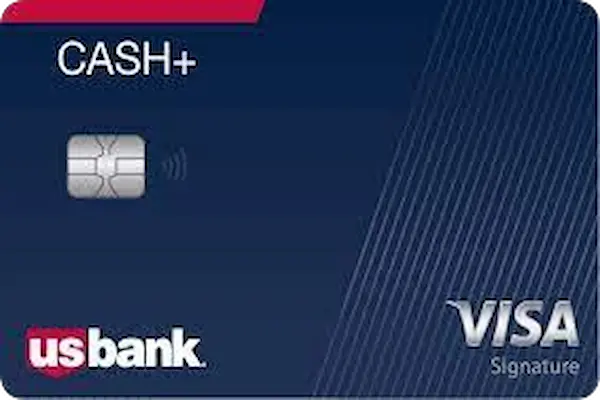
Quick facts (scannable summary)
Key fees (annual fee, balance transfer fee, foreign transaction fee)
Annual fee: $0.
Intro APR: 0% introductory APR on purchases for the first 15 billing cycles.
Intro APR on balance transfers: 0% introductory APR on balance transfers made within 60 days of account opening for the first 15 billing cycles.
Balance transfer fee: 5% of each transfer amount, with a $5 minimum.
Foreign transaction fees: U.S. Bank may charge foreign transaction fees on some cards, so confirm your specific cardmember agreement for the exact fee on this product.
Late payment and returned payment fees may apply, and exact maximums depend on your terms and account behavior.
Reward structure (earning, caps, redemption basics)
You can earn 5% cash back on your first $2,000 in combined eligible net purchases each quarter in two categories you choose.
Eligible net purchases generally means purchases minus returns or credits.
After you reach the $2,000 combined quarterly cap in your chosen 5% categories, additional purchases in those 5% categories generally earn 1% for the remainder of that quarter.
You earn 2% cash back in one everyday category you choose each quarter.
Common 2% everyday category options include restaurants, grocery stores and grocery delivery, and gas stations and EV charging stations.
You earn 1% cash back on all other eligible purchases.
If you do not activate your categories for a quarter, your eligible purchases generally earn 1% instead of 5% and 2%.
Core benefits (top 5 bullets)
- $0 annual fee.
- Two selectable 5% categories each quarter, with a clear quarterly cap.
- One selectable 2% everyday category each quarter, with no stated cap on 2% earnings.
- A welcome bonus for new cardmembers who meet the spending requirement in the first 90 days.
- Extra earning opportunities through U.S. Bank’s Travel Center and Shopping Deals, for people who already use those tools.
Eligibility and approval: what typically matters
Credit profile expectations (general, no promises)
Approval is based on U.S. Bank’s underwriting and your overall credit profile at the time you apply.
Issuers usually look at payment history, including whether you pay on time.
They often consider revolving utilization, which is how much of your available credit you are using.
They consider the age of your credit history and the mix of accounts you manage.
They also look at recent inquiries and recently opened accounts.
Your income and existing obligations matter because lenders evaluate whether a new credit line fits your budget.
Income and spend patterns that may help (general guidance)
Applications typically ask for income and housing costs.
Stable income and consistent on-time payment patterns tend to support a healthier overall profile over time.
Lower utilization can help, especially if you reduce balances in the months leading up to an application.
If your plan includes a balance transfer, it can help to be realistic about how much you can pay monthly before the intro period ends.
Application flow
This is not positioned as an invite-only product.
Most people apply through the standard U.S. Bank consumer credit card application process.
Some applicants receive a decision quickly, while others may go through additional review or verification steps.
Fees and costs you must understand first
Annual fee breakdown and what’s included
The annual fee is $0.
That means you are not relying on monthly credits or premium perks to justify a yearly cost.
The card’s value is mainly driven by how well you use the 5% and 2% category structure.
Intro APR details and what they really mean
The 0% introductory APR on purchases lasts for the first 15 billing cycles from account opening.
The 0% introductory APR on balance transfers typically requires transfers to be made within 60 days of account opening, and then lasts for the first 15 billing cycles.
After the intro period ends, a variable APR applies based on creditworthiness and the terms offered at approval.
The practical takeaway is that 0% APR is a time window you can plan around.
If you use it, the best strategy is to build a payoff plan that clears the balance before the intro period ends.
Balance transfer fee “real math”
Even with 0% intro APR, balance transfers are not free.
A 5% balance transfer fee means a $2,000 transfer can add $100 in fees immediately, depending on the $5 minimum rule.
A balance transfer can still be worth it if it replaces much higher interest elsewhere, but you should do the math before committing.
Foreign transaction fee reality check
Foreign transaction fees can make international travel and foreign online purchases more expensive.
Because fees can vary by product and by the terms associated with your account, confirm the fee in your cardmember agreement before relying on this card outside the U.S.
If you travel often, many people prefer to pair a high-earning domestic cash back card with a separate no-foreign-transaction-fee card for international use.
Rewards: earning and redemption (the real math)
How you earn with the U.S. Bank Cash+® Visa Signature® Card
Cash+ rewards depend on choosing and activating categories each quarter.
You select two 5% categories for the quarter.
You also select one 2% everyday category for the quarter.
Once your selections are active, purchases that qualify in those categories earn the elevated rates.
U.S. Bank notes that you begin earning the additional cash back a few business days after you activate your selections.
If you forget to select categories for a quarter, you generally still earn 1% on eligible purchases, but you miss out on 5% and 2% until you activate categories again.
The $2,000 quarterly cap and how it affects strategy
The 5% rate is limited to the first $2,000 in combined eligible net purchases per quarter across your two selected 5% categories.
That means you are not getting 5% unlimited, and you need to think in quarterly terms.
If you spend $2,000 across your two 5% categories, the maximum 5% cash back portion is typically $100 for that quarter, assuming all purchases qualify.
Once you cross the cap, additional spending in those 5% categories generally earns 1% for the rest of the quarter.
Your 2% everyday category does not have the same stated cap, which can make it a “set-and-forget” part of the rewards plan once selected.
Picking your two 5% categories
Cash+ is most powerful when your 5% categories align with expenses you already pay anyway.
Popular examples of 5% categories often include things like home utilities, TV and internet, fast food, and certain retail categories that are harder to bonus elsewhere.
There are also categories that can be useful temporarily, like furniture stores if you are furnishing a home, or gyms and fitness centers if that is part of your routine.
Because categories can change and merchants can code purchases in unexpected ways, it is smart to pick categories with spending you can easily verify and predict.
Picking your 2% everyday category
The 2% everyday category is where you put consistent, frequent spending.
For many people, restaurants or grocery spending can be a stable choice.
For drivers, gas stations and EV charging stations can make sense.
The key is choosing the 2% category you will actually use all quarter long, not just for one week.
Merchant coding matters more than most people expect
Category rewards usually depend on how the merchant classifies the transaction, not how you personally think about it.
A purchase can fail to earn 5% or 2% if the merchant’s code is not recognized as eligible for that category.
This is why category cards can feel inconsistent when you first start using them.
A practical approach is to test small purchases early in the quarter and review your rewards activity before you commit larger spending to a category.
Prepaid travel earning through the Travel Center
Cash+ also highlights 5% cash back on prepaid air, hotel, and car reservations booked directly in the U.S. Bank Travel Center.
The way this is typically described is that you earn base rewards on the purchase, plus an additional amount that brings the total to 5% for eligible prepaid travel bookings made through that channel.
This can be useful if you already prefer booking prepaid travel through a portal and you are comfortable with the rules that come with prepaid reservations.
It is less useful if you strongly prefer booking direct with airlines and hotels, or if you want maximum flexibility for changes and cancellations.
Online shopping boosts through Shopping Deals
U.S. Bank also promotes extra rewards through Shopping Deals in its Rewards Center with many online merchants.
This is best viewed as an optional booster rather than a guaranteed, everyday feature.
It can be valuable if the merchants you already use show up in the portal and the terms match your purchase.
It can be a distraction if you end up buying things only because a portal offers extra rewards.
Redemption options and what to watch
Cash+ cash rewards can typically be redeemed in flexible ways, including statement credits and deposits into eligible U.S. Bank accounts, among other redemption methods.
Redemption value may vary depending on how you redeem.
Minimum redemption thresholds and program rules can change over time.
One important detail is that statement credit redemptions generally reduce your balance but do not count as a payment toward your minimum payment due.
Do rewards expire
U.S. Bank states that cash back rewards can expire.
A common rule for this card’s rewards program is that cash back expires at the end of the calendar month 36 months after the billing cycle in which it was earned.
If you like simplicity, a good habit is to redeem on a schedule so you do not think about expiration at all.
Benefits deep dive
The real “benefit” is category power
With Cash+, the biggest benefit is not a luxury perk.
The biggest benefit is the ability to earn 5% in categories that can be unusually practical.
Home utilities is a standout example because it can turn recurring bills into meaningful cash back.
TV, internet, and streaming can also be a strong category because many households already pay these monthly.
Fast food can be surprisingly valuable for people who buy frequent low-ticket meals.
Retail categories can shine when you have a season of spending that matches them, like electronics purchases or furniture.
ExtendPay and “pay over time” features
U.S. Bank offers a pay-over-time feature called ExtendPay.
The details of offers can vary, including whether certain plans have a promotional fee for a limited time after account opening.
A pay-over-time feature can be useful if it helps you budget a large purchase responsibly.
It can also be expensive if fees add up and you carry balances longer than planned.
The safe approach is to treat pay-over-time as a tool, not a lifestyle.
Security and account management
Most major issuers provide fraud monitoring and tools to manage your account digitally.
The practical “benefit” here is setting up alerts, autopay, and reminders so you never miss category activation windows or payment due dates.
Because the card’s rewards depend on activation, reminders are especially useful.
Pros and cons
Pros of the U.S. Bank Cash+® Visa Signature® Card
- You can earn 5% cash back in two categories you choose each quarter.
- You can choose a 2% everyday category each quarter.
- The card has a $0 annual fee.
- The category list includes options that are often hard to bonus on other cards, like home utilities and TV or internet services.
- There is a welcome bonus that can add value in the first few months if you meet the spending requirement.
- A 0% intro APR window on purchases and qualifying balance transfers can be useful for planned financing.
Cons of the U.S. Bank Cash+® Visa Signature® Card
- You must activate categories every quarter, or you will miss the 5% and 2% earnings.
- The 5% tier is capped at $2,000 in combined purchases per quarter across the two selected 5% categories.
- Merchant coding can cause surprises where a purchase earns less than expected.
- Foreign transaction fees may apply, so it may not be ideal for international travel depending on your terms.
- Rewards can expire under program rules, which adds one more thing to keep in mind if you rarely redeem.
Who this card is best for, and who should skip
Best-fit profiles (3 profiles)
Profile 1: The bill-payer who has steady expenses like utilities, internet, and streaming and wants to turn those recurring costs into high rewards.
Profile 2: The optimizer who already has a flat 2% card and wants Cash+ as a quarterly “booster” for two categories.
Profile 3: The planner who is comfortable doing a quarterly activation routine and can keep spending inside the 5% cap.
Not a fit if… (3 profiles)
Not a fit 1: You want true set-it-and-forget-it rewards with no quarterly activation.
Not a fit 2: Your spending in the best categories is far above the quarterly cap and you do not want to manage overflow with another card.
Not a fit 3: You travel internationally often and want a card that clearly advertises no foreign transaction fees.
Head-to-head comparisons (SEO powerhouse)
U.S. Bank Cash+® Visa Signature® Card vs Wells Fargo Active Cash® Card
Active Cash-style cards focus on a flat rewards rate across nearly all purchases.
Cash+ focuses on higher rewards in selected categories, with a cap and activation requirements.
If you want simplicity, a flat-rate card often wins.
If you want category power in unusual categories like utilities, Cash+ can win for the specific spending it targets.
Many people combine the two, using Cash+ for 5% categories and a flat-rate card for everything else.
U.S. Bank Cash+® Visa Signature® Card vs Bank of America® Customized Cash Rewards
Both cards allow customization.
Cash+ lets you choose two 5% categories and one 2% category each quarter, with a quarterly cap on the 5% portion and required activation.
Customized Cash Rewards typically focuses on one 3% choice category plus 2% at grocery stores and wholesale clubs, with a quarterly cap that applies to both bonus tiers.
Cash+ can offer a higher ceiling in its selected categories, but the activation routine is more demanding.
Customized Cash Rewards can feel easier, especially if your spending centers on one main category.
What you gain or give up at each price tier
At the $0 annual fee tier, you are usually optimizing for rewards rate and simplicity.
Cash+ leans toward rewards rate in chosen categories, even if it costs you some simplicity.
As you move into annual-fee cards, you are often paying for travel perks, credits, and premium protections.
If your goal is straightforward cash back and you do not want premium perks, a $0 annual fee strategy can be more sustainable long term.
How to apply for the U.S. Bank Cash+® Visa Signature® Card step by step
Application steps
Step 1: Review the current welcome bonus terms, including the spending requirement and the 90-day window.
Step 2: Review the intro APR terms, including how long the 0% period lasts and the rule about balance transfers made within 60 days.
Step 3: Confirm you understand the rewards structure, especially the need to activate categories each quarter.
Step 4: Gather your personal details, including address history, employment details, income, and housing costs.
Step 5: Submit the application with accurate information.
Step 6: If requested, complete any identity verification or follow-up steps.
Step 7: After approval, activate the card and set up online access.
Step 8: Go into the rewards experience and select your two 5% categories and your one 2% category for the quarter.
Step 9: Set reminders for quarterly category selection so you do not miss activation windows.
What to prepare before you apply
Know your total annual income and your monthly housing payment.
If you plan to do a balance transfer, have the other account details ready and estimate the impact of the 5% transfer fee.
If you want the welcome bonus, plan how you will reach the spending requirement using normal expenses, not “extra” purchases.
If your strategy depends on utility bills or internet providers, confirm those payments will code in the way you expect before relying on them.
What happens after approval
You will receive the card and activate it.
You will choose and activate your categories to start earning at the elevated rates.
You will set up payments, autopay, and alerts to avoid late fees and protect your credit profile.
You will track your 5% spending against the quarterly cap so you know when to switch spending to another card.
Alternatives if you want similar value for less effort
Best alternative if you want “one rule” rewards
If you want a simple experience with minimal management, a flat-rate 2% cash back card can be easier.
This approach is especially appealing if you do not want to activate categories or track a quarterly cap.
Best alternative if you want automatic category rewards
If you want higher rewards in categories without activating quarterly, you may prefer a card that automatically applies bonus rates to a set list of categories.
This can feel smoother, even if the bonus rate is lower than 5%.
FAQs
Is the U.S. Bank Cash+® Visa Signature® Card worth it?
It can be worth considering if you will reliably activate categories and your spending fits the categories and cap.
It can be even more valuable if you use it for bills like utilities or internet that you pay every month anyway.
Do I have to activate categories to earn 5% and 2%?
Yes, you generally need to choose and activate categories each quarter to earn the 5% and 2% rates.
If you do not activate, eligible purchases generally earn 1% for that quarter.
What is the maximum 5% cash back I can earn each quarter?
The 5% rate applies to the first $2,000 in combined eligible net purchases each quarter across your two selected 5% categories.
Spending above that threshold in those categories typically earns 1% for the remainder of the quarter.
What are the 2% categories?
Common 2% everyday category options include restaurants, grocery stores and grocery delivery, and gas stations and EV charging stations.
Always confirm the current options when you are selecting categories because program options can change.
Is there a welcome bonus?
Yes, a common offer is a $200 rewards bonus after spending $1,000 in eligible purchases within the first 90 days of account opening.
Offers can change, so always confirm the bonus terms shown in your application.
Does the card offer 0% intro APR?
Yes, the card is commonly offered with 0% intro APR for the first 15 billing cycles on purchases.
It is also commonly offered with 0% intro APR for the first 15 billing cycles on balance transfers made within 60 days of account opening.
Do rewards expire?
Yes, the rewards program rules typically include expiration.
A common rule is that cash back expires at the end of the calendar month 36 months after the billing cycle in which it was earned.
How do I redeem my cash back?
Redemption methods commonly include statement credits and deposits to eligible U.S. Bank accounts, along with other options.
Redemption values and minimums can vary by method and can change over time.
Disclosures
Rates and fees disclaimer
Rates, fees, categories, caps, and promotional offers can change at any time.
Your APR, credit limit, and approval outcome depend on creditworthiness and the issuer’s underwriting.
Always review the official pricing, program rules, and cardmember agreement for the version of the offer you apply under.
Editorial and affiliation disclosure
This article is for informational purposes only.
We are not U.S. Bank.
We do not represent U.S. Bank or Visa.
We are not affiliated with any institution mentioned.
All trademarks belong to their respective owners.


